Spackle War
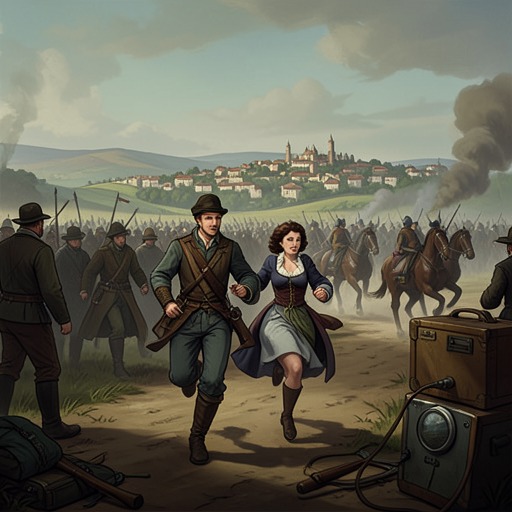
The Knife of Never Letting GoThe Spackle War is the conflict that turned the settlers’ difficult beginning on New World into a campaign that destroyed most of the Spackle community and reshaped human life. Todd Hewitt first learns a confident, simplified account: the Spackle opposed the settlers, used germs as weapons, and were defeated after the Noise germ killed women and many men. Ben later corrects a crucial part of that history. The Noise was not a Spackle weapon at all, but a natural phenomenon of the planet; human hardship and a movement that blamed the Spackle helped make war possible. The change in account shifts the conflict from a tale of human self-defense to a history of fear, prejudice, and unequal force.
The Settlers’ Account
When Viola asks why animals speak and why she hears thoughts beyond spoken words, Todd explains the history he has been taught. Settlers arrived about twenty years earlier to found New World, where they encountered the Spackle, who, according to the accepted story, did not want them there. The settlers tried to make peace for years, Todd says, but eventually war began. This is presented as inherited knowledge, familiar to the boys of Prentisstown rather than as a history Todd has investigated for himself.
In that version, the Spackle fought with diseases. One germ was believed to have been intended to kill livestock but instead made animals able to talk. Another was said to be the Noise germ. Todd’s account associates it with the deaths of half the men and all the women, including his mother, and with the exposure of surviving men’s thoughts. When Viola asks whether any aliens remain, Todd answers that there are none. The certainty of that answer reflects the official story he has received; Ben’s later account will make its absolute conclusion less secure.
Ben’s Correction
Years later, Ben explains that the Noise germ was not Spackle warfare. The phenomenon already existed in the air when the settlers arrived, and within a day people could hear one another’s thoughts. Viola identifies the qualification that Todd’s earlier account had obscured: it was not everyone. Her silence makes the difference audible in the scene, while Ben’s explanation revises the settlers’ understanding of what the planet is. He describes New World as a place where living things communicate continually. The Spackle had evolved within that condition; the human settlers had not. For them, an excess of information became Noise.
This correction matters because the familiar account had treated a planetary condition as an enemy attack. It also changes the meaning of the settlers’ encounter with the Spackle. The Spackle understood a world of ceaseless information, while the newcomers experienced it as an assault they could not control. Ben does not present the resulting human fear as proof that the Spackle had attacked them. Instead, he separates the existence of Noise from the later political account that made the Spackle responsible for human suffering.
From Hardship to War
Ben places the war within years of worsening conditions across New World. Crops failed, sickness persisted, and prosperity remained out of reach. In that setting, preaching spread that blamed the Spackle. What began as blame became a movement, and the movement became war. Ben’s sequence gives the conflict a human political cause: hardship did not simply produce violence on its own; it was given a target by a growing campaign against the aliens.
The forces were not equal. Humans had guns, Ben says, while the Spackle did not, and the result was the end of the Spackle as a people in the places humans controlled. Todd interrupts the apparent finality of that conclusion: not all of them were gone. Ben confirms that some survived, but had learned not to come near humans. His qualification recasts Todd’s earlier assertion that there were no aliens left. The war’s outcome was devastating without being an absolute extinction, and its survivors remained separated from the human communities that had fought them.
Death, Burial, and the War’s Aftermath
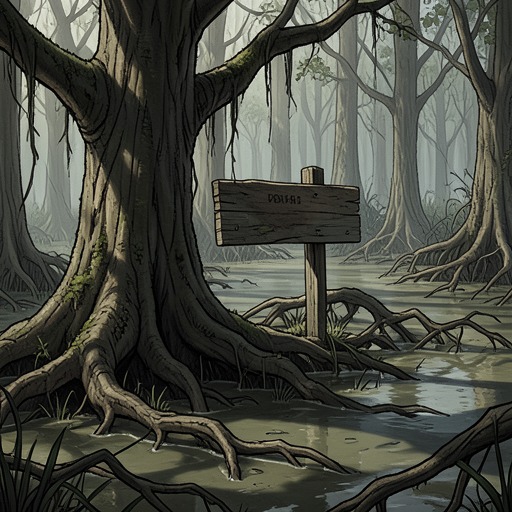
The consequences of the war persist in the landscape Todd knows. Spackle dead were put into the swamp, where water and muck could receive them without poisoning the surrounding ground. Ben’s explanation, as Todd understands it, contrasts this practice with human burial and presents the swamp as able to absorb ordinary numbers of bodies. The war overwhelmed that capacity: so many Spackle died that their remains accumulated in heaps, and the swamp took a long time to become swamp again. This history is not a distant abstraction for Todd; he was born into the aftermath, amid an overcrowded swamp and cemetery.
The war’s human casualties and the swamp’s history are often compressed into the same account of germs, madness, and death. Ben’s correction requires those claims to be distinguished. Todd had been taught that the Noise germ killed half the men and every woman, and that the war ended the Spackle. Ben establishes that Noise itself was already part of New World, while separately explaining how anti-Spackle preaching became a war and how armed humans defeated the Spackle. The available account therefore revises the cause of the conflict without making every remembered claim about the deaths disappear.
The war also precedes, but is distinct from, the violence in Prentisstown that Todd learns about from Ben. After the Spackle had been killed, many men of Prentisstown turned against the women and against men who tried to protect them, under the influence of Mayor Prentiss and Aaron’s preaching. Jessica Elizabeth, the town’s mayor, foresaw the danger and organized girls and younger boys to flee across the swamp; Mayor Prentiss’s men attacked before she could leave with the women and their defenders. This later account does not make the Prentisstown killings part of the Spackle War. It shows instead how the war’s history of blame and violence sits beside another concealed history that Todd had also been taught incorrectly.
Historical Significance
The Spackle War is narrated through competing levels of knowledge rather than as a fully witnessed battle. Todd first repeats the version that every Prentisstown boy is expected to know; Ben’s account, given in the presence of Viola, opens that version to correction. The shift is especially consequential because the familiar story treats human victory as a completed defense against a vanished enemy, whereas Ben describes a movement of blame, a military imbalance, surviving Spackle, and a continuing distance between the survivors and human beings.
The event’s legacy is carried in both place and memory. The swamp preserves the scale of the deaths in a landscape that took years to recover, while Todd’s inherited account preserves the assumptions that made the war intelligible to his town. Ben’s testimony does not restore a complete record of every cause or casualty, but it exposes the certainty with which human responsibility had been obscured. The war’s decisive consequence is therefore not only the defeat of the Spackle: it is the creation of a history in which the victors’ explanation must itself be questioned.